Most villa owners start speaker planning with a single question — "which speakers should I buy?" — when the question that actually determines whether the system works is "where are my zones, and what does each one need to survive?" A villa in the UAE or Saudi Arabia isn't one acoustic space. It's a living room, a majlis, a kitchen, a set of bedrooms, a garden, a pool deck, and often a covered terrace that sits somewhere between indoor and outdoor. Each of those zones has different acoustic needs and, in this climate, different physical demands on the hardware itself. Planning the zones first is what separates a system that still sounds right in year five from one that starts failing in its first summer.
Why Villa Audio Needs a Zoning Plan, Not Just a Speaker List
A zoning plan is simply a room-by-room (and area-by-area) map of what each space is used for, how it's used, and who's controlling it. A majlis used for evening gatherings needs different coverage and volume behaviour than a family TV room. A kitchen needs background-level, even coverage rather than a stereo "sweet spot." A garden used for entertaining needs broader, more even outdoor coverage than a single feature speaker by the pool. Working this out before choosing hardware avoids the two most common villa-audio mistakes: under-speccing rooms that get heavy use, and over-speccing quiet corners that never needed it.
It also determines wiring and amplifier planning early, which matters a lot in villas — running cable after walls are closed is expensive and disruptive, so the zoning map should exist before first fix, not after.
Indoor Zones: Living Areas, Majlis, and Bedrooms
Indoor zones are the more forgiving half of the plan, but they're not interchangeable. Open-plan living and dining areas usually want ceiling or in-wall speakers spread for even coverage rather than a single stereo pair, since people move through the space rather than sitting in front of it. A majlis, culturally and functionally a room for hosting, benefits from the same even-coverage approach but often at a slightly higher output ceiling, since it's the room most likely to host a large group at volume. Bedrooms and studies are usually the opposite case — lower output, simpler zoning, sometimes just a single ceiling pair — because the use case is closer to personal listening than group entertaining.
Indoor speakers don't need to deal with heat, humidity, dust, or UV exposure, so the hardware constraints are mostly about finish (matching ceiling colour, grille style) and acoustic performance rather than survival. In practice, this is where an entry point like Artsound's FLAT series earns its place — an ultra-thin, frameless, paintable in-ceiling speaker built for exactly this kind of unobtrusive, budget-conscious living-area and kitchen coverage. A majlis or a master bedroom that's meant to be a step up in sound quality is a better fit for the INTIIMI series, which trades the FLAT line's minimalism for higher-end components and a flush-mount finish. Kitchens and home offices sit in between, where the HAPPI series' water-resistant build adds a bit of headroom without the cost of a fully outdoor-rated speaker.
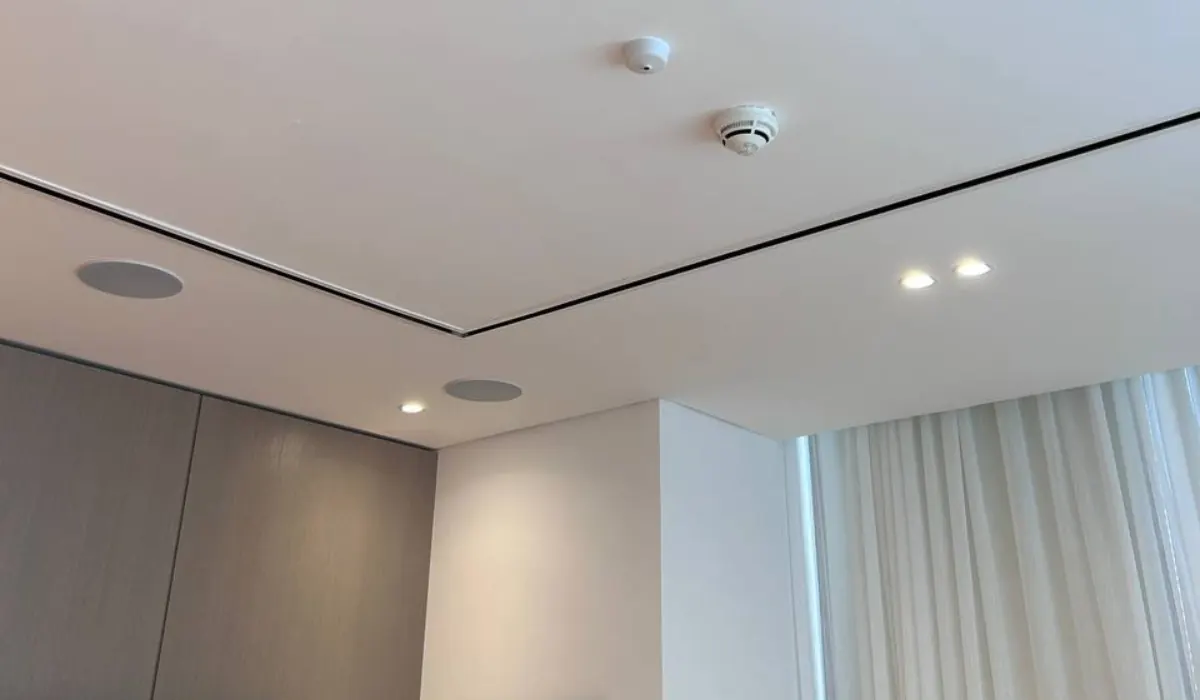
In-ceiling speakers built flush into the ceiling, kept discreet alongside the lighting and fire safety fittings.
Outdoor Zones: Garden, Pool, and Terrace — Where the Gulf Climate Changes the Plan
Outdoor is where villa audio planning genuinely diverges from anywhere with a milder climate. A garden, pool deck, or open terrace in the UAE or Saudi Arabia isn't just "outside" — it's outside with direct summer sun that can push surface temperatures on dark housings well past 60°C, humidity that swings sharply between winter mornings and summer afternoons, wind-blown sand and dust, and, near a pool, sustained exposure to chlorinated water and splashing. Standard indoor speaker components — paper cones, untreated wood housings, exposed wiring — degrade quickly under that combination. This is the single biggest reason "just move an indoor speaker outside" fails within a season or two.
The practical answer is hardware built specifically for this: weatherproof, UV-stable enclosures, sealed drivers, and rust-resistant hardware rated for continuous outdoor use rather than occasional exposure. It's the reason Dedott specs Artsound's outdoor range for garden, pool, and terrace zones on villa projects across the UAE and Saudi Arabia — that line is built around exactly this exposure profile, rather than a standard driver in a weather-resistant shell.
A few concrete examples of how that plays out zone by zone: an open garden or pathway is a natural fit for a rock-shaped speaker like Artsound's ROCKS — an IP54-rated, UV- and water-resistant unit built into a faux-stone housing so it disappears into planting rather than sitting on display, which matters for gardens that are also part of the landscaping design. A pool deck or open terrace wall, where the speaker needs to mount flush and stay visible as part of the layout rather than hide, is better served by the Outsiders on-wall line or the ASW series (for example the ASW550, built around a weather-resistant driver and tweeter rated for indoor/outdoor use, up to the higher-output ASW800 for larger open areas). A covered terrace or outdoor kitchen — technically sheltered but still exposed to condensation, splashing, and humidity — is where Artsound's Waterproof in-ceiling series fits, giving the same flush ceiling install as an indoor room but with housing built to withstand moisture. (Exact model availability should be checked against Dedott's current UAE stock list before this goes live — the examples above reflect Artsound's published product range.)
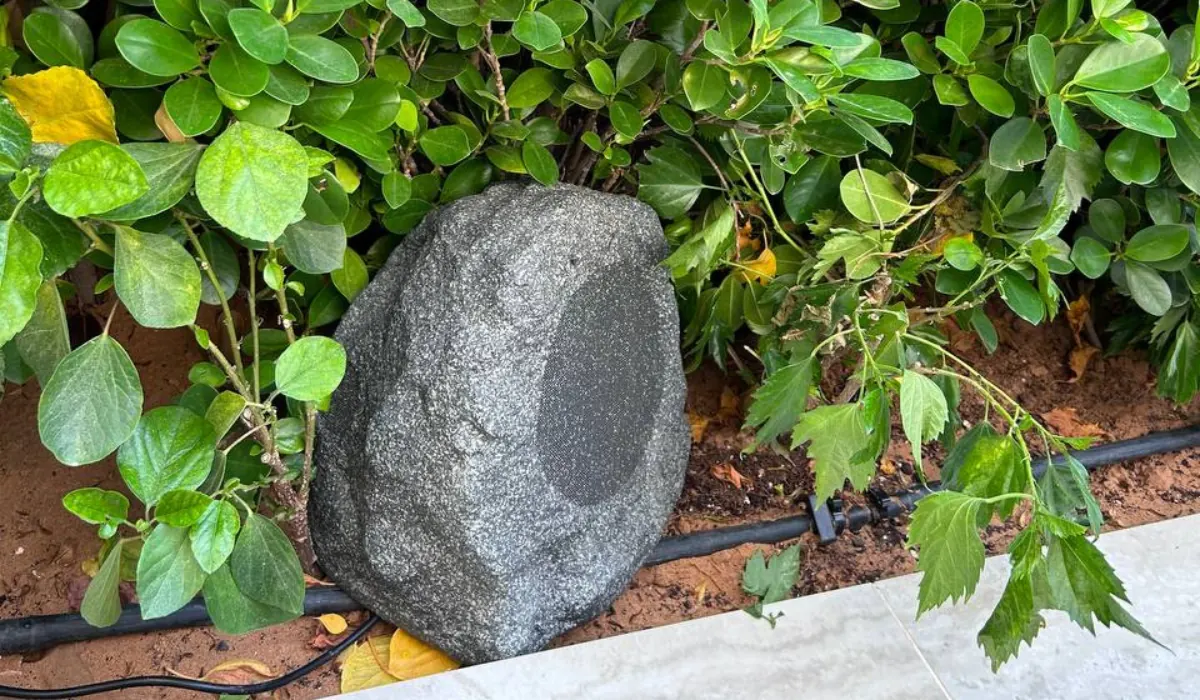
An Artsound ROCKS speaker disguised as a garden stone, tucked into the landscaping rather than sitting on display.
Rule of thumb for covered vs. exposed zones: a covered terrace still needs a genuine outdoor-rated speaker if it's open on the sides — wind-driven rain and humidity reach it the same as an uncovered garden. Reserve "indoor-rated" hardware for spaces that are fully enclosed, not just roofed.
IP Ratings and Weatherproofing: What Actually Matters in the Gulf
IP (Ingress Protection) ratings describe resistance to dust and water on a two-digit scale — the first digit for solids, the second for liquids. For UAE and Saudi Arabia outdoor zones, the number that matters most day-to-day is usually the first digit, because sand and dust ingress is a bigger long-term threat here than rainfall. A speaker rated for splash resistance but not dust sealing will often fail from grit working into the driver before it ever fails from water. Pool-adjacent placements are the exception — there, splash and humidity resistance both matter, and mounting height/distance from the water line should be planned alongside the rating itself, not as a substitute for it.
Beyond the IP number, two things are easy to overlook: cable and connector protection (a weatherproof speaker fed by an indoor-rated cable run is only as protected as its weakest point), and direct, unshaded sun exposure, which stresses housings and drivers even when moisture isn't the issue.
Zone-by-Zone Summary
Indoor Zones
Living areas, majlis, bedrooms, kitchen. Priority: even coverage, finish, discreet mounting. Typically FLAT (entry ceiling), INTIIMI (higher-end ceiling) or HAPPI (water-resistant, kitchens/offices).
Covered but Open Zones
Covered terraces, outdoor kitchens, majlis extensions open on one or more sides. Priority: outdoor-rated hardware — covered is not the same as enclosed. Typically the Waterproof in-ceiling series.
Fully Exposed Zones
Garden, pool deck, open terrace. Priority: outdoor-rated, UV-stable, dust- and splash-resistant hardware built for continuous exposure. Typically ROCKS (garden, IP54), Outsiders or ASW on-wall series (pool deck/terrace walls).
One System, Many Zones: Why Control Matters as Much as the Speakers
Once a villa has five, eight, or a dozen zones, the hardware choice per zone is only half the plan — the other half is how someone actually controls all of it. A separate remote or app per zone becomes unmanageable fast, which is why most well-planned villa systems route every zone, indoor and outdoor, through a single multiroom amplifier setup controlled from one app: turn on garden and pool together for a weekend gathering, keep the majlis independent for an evening, mute everything from one screen when it's time to leave. Getting this right depends on planning the zones and the control layer together from the start, rather than adding control as an afterthought once the speakers are already installed.
Planning a villa system of your own? Send us your floor plan and we'll map the zones and recommend hardware for each one — see our villa multi-zone planning guide or browse the full Artsound speaker range we distribute.
FAQ
Can I use the same speakers indoors and outdoors to keep the system simple?
Not for genuinely exposed outdoor zones. Indoor speakers aren't built to survive the heat, humidity, and dust common to the UAE and Saudi Arabia, and using them outside typically shortens their working life to a season or two. Zoning the plan by exposure, not by matching every speaker, keeps the system both simpler to control and more durable.
Does a covered terrace need outdoor-rated speakers?
Usually yes, if it's open on any side. A roof blocks direct rain but not humidity, wind-blown dust, or splash — the things that actually degrade indoor-rated hardware over time.
What's the biggest planning mistake villa owners make with outdoor audio?
Treating "outdoor" as one zone instead of several. A shaded garden corner, a sun-exposed pool deck, and an open terrace all have different exposure levels, and speccing them the same way usually means over-speccing some areas and under-protecting others.
Should indoor and outdoor zones be on the same control system?
Yes, where possible. A single multiroom app covering every zone — indoor and outdoor — makes day-to-day use far simpler than juggling separate systems, and it's easier to plan for correctly from the start than to retrofit later.